AIJC at UNESCO Conference: A Call to Transform Media and Information Literacy Education in the Age of AI
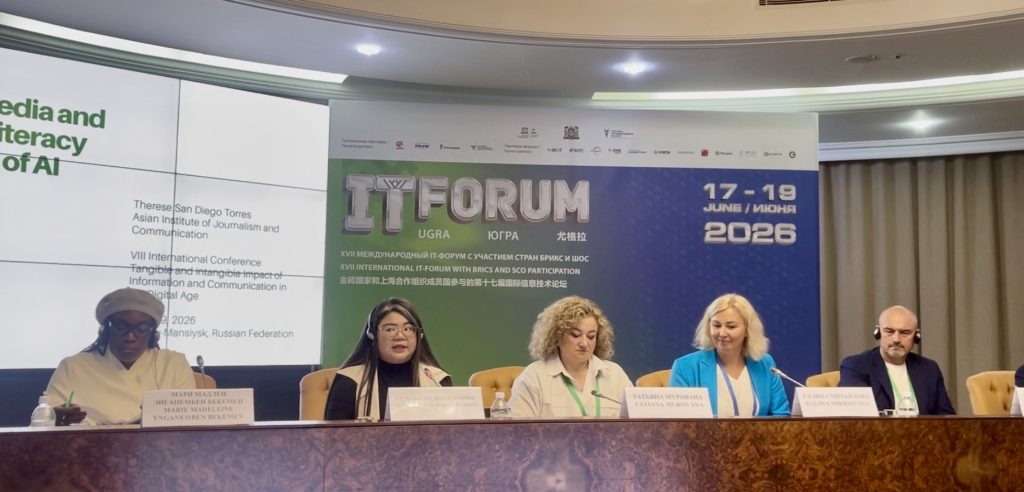
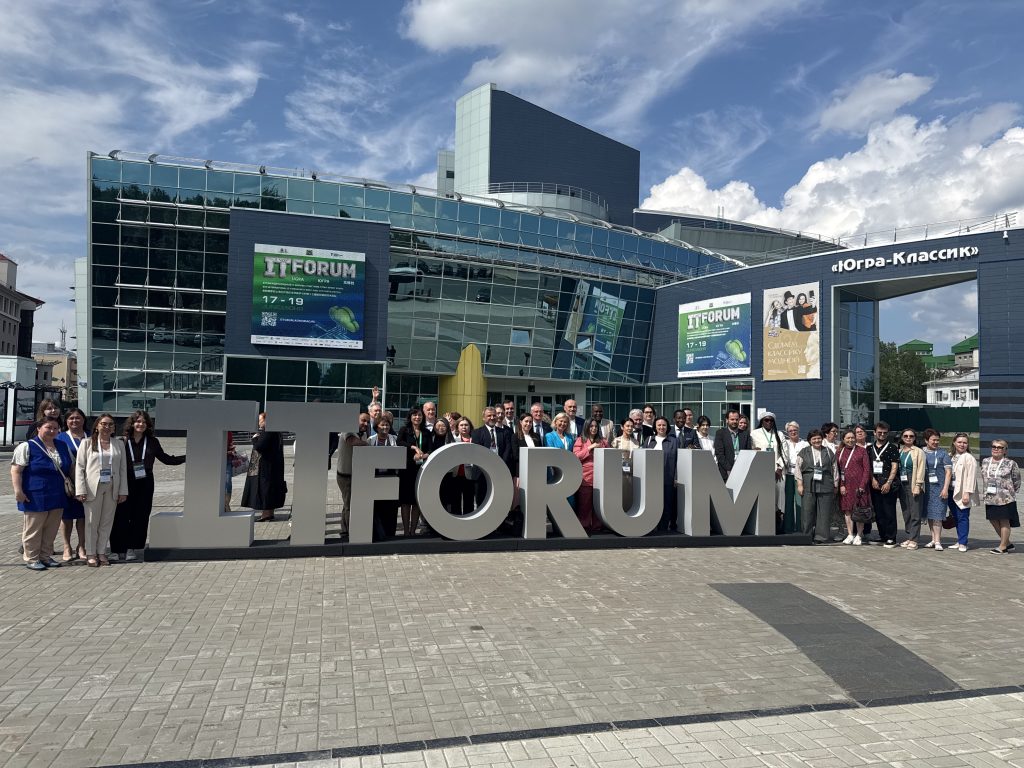
Asian Institute of Journalism and Communication (AIJC) President Therese San Diego Torres called for a fundamental rethinking of media and information literacy education in the age of artificial intelligence during the VIII International Conference on Tangible and Intangible Impact of Information and Communication in the Digital Age, held in Khanty-Mansiysk, Russian Federation, from June 17–19, 2026.
Torres was among the invited speakers in the session, “Information Literacy in the New Digital Environment: Trust, Confidentiality, Responsibility,” moderated by UNESCO Institute for Information Technologies in Education (IITE) Project Officer in Education Tatiana Murovana. The conference was organized in the framework of the implementation of the UNESCO Information for All Programme (IFAP) and the XVII International IT Forum.
In her presentation, Torres emphasized that artificial intelligence is transforming how people create, consume, and evaluate information, making it necessary to update and expand media and information literacy education. She noted that learners today must develop the ability to understand not only whether information is accurate, but also who created it, how it was produced, what evidence supports it, and what biases or influences may shape it. Equally important, she said, is cultivating intellectual humility, the willingness to revise one’s views when presented with stronger evidence.
Drawing from 2025 studies in the Philippines, Torres highlighted the growing dependence of students on generative AI tools and the resulting decline in intellectual engagement. She cited research showing that students themselves recognize this dependence as “dishonest” and detrimental to genuine learning, producing a “false sense of achievement without true understanding” (Secreto et al., 2025; Rodrigo et al., 2025).
She noted that these concerns extend beyond the Philippines. A 2025 survey of young adults in the United States found that a large proportion of Generation Z expressed anxiety about losing essential cognitive and skill-building opportunities due to overreliance on AI tools (Lira et al., 2026).
Torres argued that the role of educators should not be limited to detecting AI-generated content or enforcing restrictions. Instead, educators should focus on helping students further understand what is lost in cognitive development when they outsource thinking, research, and writing to machines. At the same time, educators should equip their students to strengthen core competencies by first modeling fundamental skills, before introducing the ethical use of AI tools—a key lesson emphasized in AIJC’s training program on the ethical use of AI in research and writing.
Another key theme in the presentation was the importance of youth participation in shaping AI literacy education. Torres emphasized the need to design learning approaches that align with behaviors and motivations of younger generations. To support this, she highlighted the use of culturally relevant communication channels, including social media and popular culture. She shared an example of a collaboration among AIJC, the National Library of the Philippines, the National Commission for Culture and the Arts, and P-Pop group SB19. Through such partnerships, educational content for promoting appreciation of national cultural heritage, memory institutions, and historical artifacts is produced for, and with, young people.
She noted that this approach aligns with broader international efforts to engage the youth in education and cultural advocacy, such as UNESCO’s collaboration with K-pop group Seventeen.
Torres concluded that the future of AI in education depends on ethical leadership and responsible use. Students, she said, should be empowered to understand both the capabilities and limitations of AI and to use these technologies as tools that enhance, rather than replace, human judgment, creativity, and critical thinking.
These ideas continue to shape AIJC’s initiatives. On July 3, 2026, the Institute’s new learning huddle series, AIJC Footnotes, featured a discussion on Academic Integrity and AI led by AIJC faculty member Dr. Pauline Gidget Estella. The session reinforced AIJC’s commitment to promoting the ethical use of AI while strengthening critical thinking and academic integrity.
Murovana and Torres are also members of the UNESCO Information Literacy Working Group (ILWG), one of the groups working on the implementation of UNESCO Information for All Programme.