AIJC Footnotes Learning Huddle Explores Why Digital Safety is More Than a Tech Problem

Digital safety is no longer just about protecting devices and passwords. It is about protecting people, identities, information, and the ability to safely navigate the digital world.
This was the central message of the Asian Institute of Journalism and Communication (AIJC) Footnotes Learning Huddle on Digital Safety, held online on August 7, featuring Ellie Glino of Qurium Media Foundation.
Qurium is a Sweden-based organization of digital rights advocates, known for conducting forensic digital investigations on internet censorship, disinformation campaigns, and targeted phishing campaigns against media and human rights organizations.
During the discussion, participants raised concerns ranging from maintaining anonymity on social media and data privacy, to misinformation, disinformation, scams, AI use, and account security.
Glino emphasized that safety should be built into everyday habits, rather than treated as an afterthought. Prevention remains one of the most basic principles of security. Websites such as “Have I Been Pwned” can help people check whether their information has appeared in known data breaches.
The discussion highlighted an everyday vulnerability: attention. Scams and other attacks often succeed when people are tired, distracted, or emotionally triggered.
Glino noted, however, that digital threats can go far beyond stolen data.
The session looked at distributed denial of service (DDoS) attacks against media organizations and technologically facilitated gender-based violence against women journalists as examples. Such attacks can have physical, psychological, and professional consequences.
“Mitigation is no longer enough,” Glino said, pointing to the need to build resilience and prepare for an increasingly hostile digital environment.
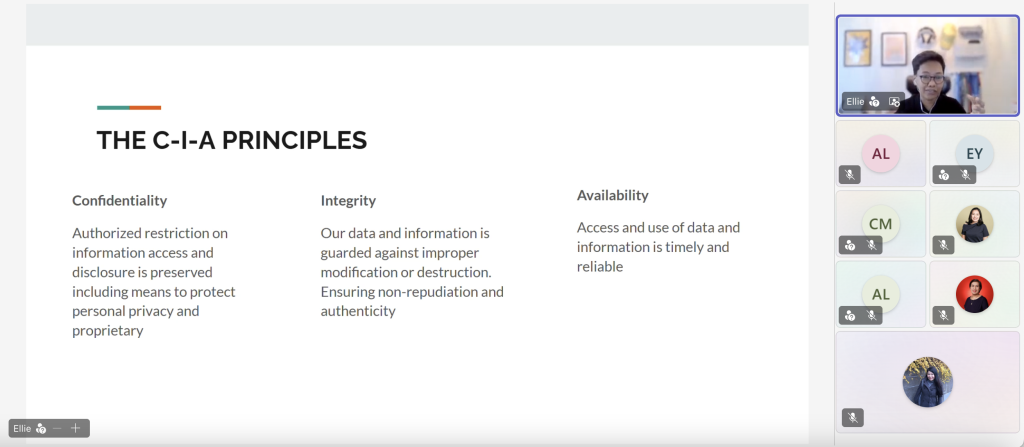
To make digital safety easier to understand and apply, Glino introduced practical frameworks, including the confidentiality, integrity, and availability (CIA) model, as well as a holistic security model covering physical, psychosocial, and digital security.
This was the second learning huddle in the series organized by AIJC in response to student recommendations. AIJC students were encouraged to bring guests to the session.