AIJC Footnotes Learning Huddle Sparks Conversations on AI and Academic Integrity
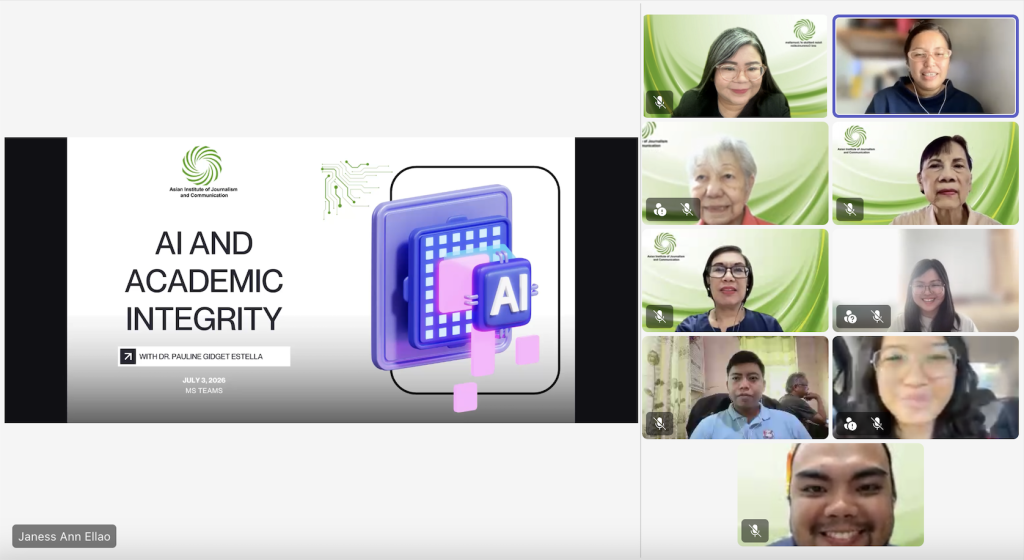

With generative AI now commonly used in classrooms and academic spaces, how can educators and researchers explore its potential while safeguarding learning and academic integrity? This question set the tone for the very first session of the AIJC Footnotes Learning Huddle on July 3, 2026.
In response to student feedback identifying AI as a key area of interest, the free online session on AI and Academic Integrity was organized by the Asian Institute of Journalism and Communication (AIJC) via MS Teams, led by faculty member Dr. Pauline Gidget Estella.
AIJC students and their guests participated in the online session.
AIJC President Therese San Diego Torres underscored in her opening remarks the need for ethical, transparent, and responsible AI use that strengthens, rather than undermines, scholarship.
She shared that the session builds on AIJC’s continuing work in media and information literacy and follows the Institute’s participation in the UNESCO VIII International Conference on the Tangible and Intangible Impact of Information and Communication in the Digital Age in June. The global discussions, she noted, have opened opportunities for collaboration with UNESCO on responsible AI governance, digital literacy, and future learning initiatives.
Dr. Estella then unpacked the opportunities and challenges of generative AI. She urged participants to look beyond AI’s convenience and consider the bigger questions surrounding the technology, from data colonialism and intellectual property to privacy, AI hallucinations, and its environmental footprint. She also introduced the concept of “cognitive atrophy,” warning that excessive dependence on AI could weaken people’s ability to think, write, and solve problems independently.
At the same time, Dr. Estella emphasized that AI is not something to fear or reject outright. It has real value in research and journalism, particularly for tasks such as transcription, proofreading, and analyzing large datasets. What remains essential, she stressed, is human oversight. AI may generate text quickly, but it cannot replace critical thinking, creativity, ethical judgment, or a writer’s unique voice.
The discussion continued in an engaging Q&A moderated by President Torres, with AIJC Graduate School students exploring topics ranging from AI regulation and teacher training to media and information literacy and the future of learning assessment. Dr. Estella called for guided and informed AI use grounded in strong foundations in writing, research, and critical thinking.